
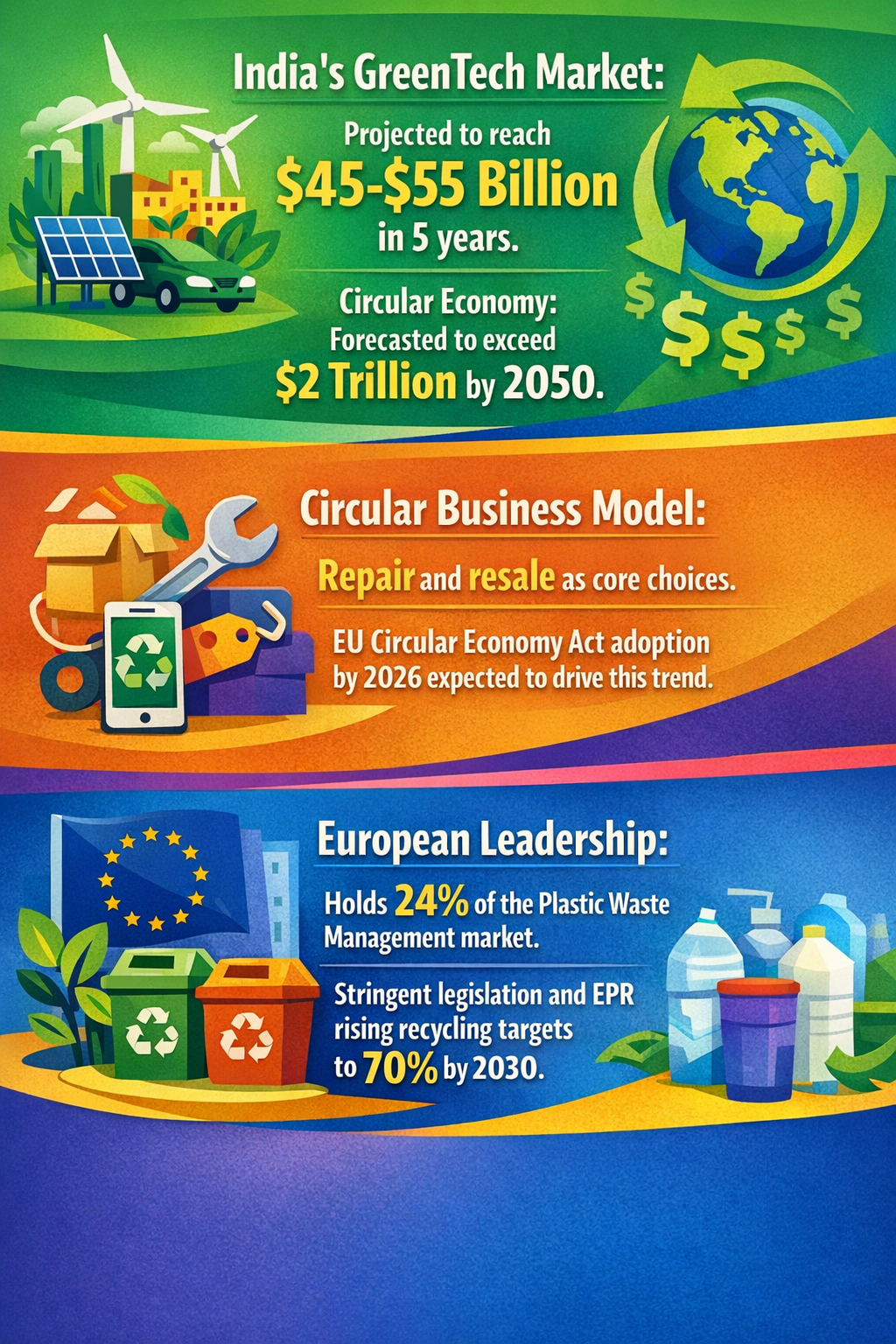
Despite ambitious targets, geopolitical conflicts, supply chain disruptions, and fragmented regulations stall circular economy progress globally. Plastic waste continues to accumulate as recycling infrastructure fails to scale, and businesses revert to linear "take-make-waste" models to preserve short-term profits. Consumer fatigue and misinformation reduce demand for sustainable products, while environmental degradation accelerates.
Key signals: Slowing enforcement of EU Circular Economy Act beyond 2026; increasing trade barriers impacting environmental goods; underinvestment in recycling technology and infrastructure.
What could Horizon Scanning | Scenario Planning | Strategic Intelligence | Shaping Tomorrow do?
Volatile policy environments and mixed consumer reception cause circular economy adoption to be uneven and regionally polarized. Some sectors rapidly embrace repair and resale business models, while others struggle with high costs or lack of viable recycling technology. Material prices fluctuate, leading to speculative investments and supply shortages. Collaborative platforms arise but face trust and interoperability challenges.
Key signals: Emerging reuse mandates coupled with uneven regulatory integration; price swings in recycled plastics; pilot circular supply chains with mixed performance data.
What could Horizon Scanning | Scenario Planning | Strategic Intelligence | Shaping Tomorrow do?
Governments and industries cautiously advance circular economy initiatives, emphasizing regulatory compliance combined with economic competitiveness. Incremental improvements in recyclability and reuse targets drive steady gains but leave systemic challenges unresolved. Investments prioritize safe, proven recycled materials and repair services, while new innovations enter the market with rigorous validation. Cross-sector partnerships deepen but remain focused on risk reduction and cost control.
Key signals: Adoption of EU Circular Economy Act with phased implementation; controlled scaling of circular business models; investment in sustainable construction materials.
What could Horizon Scanning | Scenario Planning | Strategic Intelligence | Shaping Tomorrow do?
By decisively aligning policy, investment, and innovation, regions emerge as circular economy leaders. Circular supply chains become standard, plastic packaging is ubiquitously recyclable or reusable, and repair/resale are core business practices. Technology integration in tracking materials and verifying sustainability claims establishes trust. Investors prioritize companies with circular strategies, creating virtuous cycles of growth and environmental benefit.
Key signals: Enforcement of Packaging and Packaging Waste Regulation by 2030; rising investment in clean technology and critical minerals; growth in circular-focused environmental consulting.
What could Horizon Scanning | Scenario Planning | Strategic Intelligence | Shaping Tomorrow do?
The circular economy catalyzes a global transformation that curbs waste, decouples growth from resource extraction, and fosters resilient communities. Circular practices permeate all sectors—from materials to energy to services—enabled by transparent data systems and inclusive governance. Equitable access to circular jobs and technologies improves livelihoods, while environmental health is restored.
Insights from other scenarios highlight the importance of early risk mitigation, adaptive agility, consistent enforcement, and strategic leadership to reach this future.
What actions could Horizon Scanning | Scenario Planning | Strategic Intelligence | Shaping Tomorrow take now?
Sources: (Environment Journal); (Scientific Advice); (Lowy Institute); (Mordor Intelligence); (Healix); (IESE Insight)