
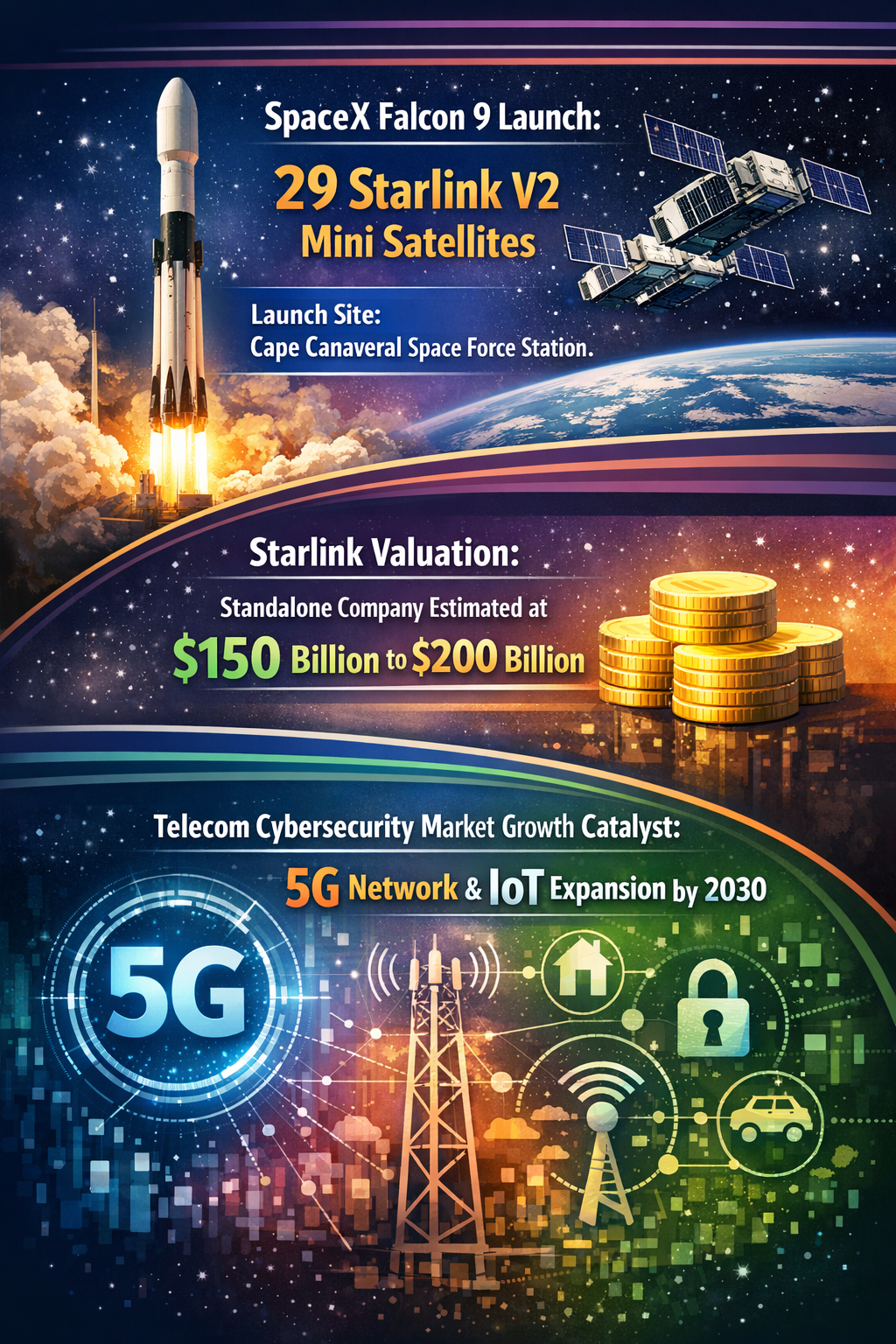
Beyond 6G and Starlink: The Quiet Shift Toward Distributed Compute-Enabled Satellite IoT Networks
Emerging in the overlap of satellite constellations, 6G integration, and neuromorphic edge processing is a weak but consequential signal: the fusion of direct-to-device satellite connectivity with on-device AI-driven data processing for Internet of Things (IoT) networks. This subtle inflection may reshape global connectivity architectures, regulatory paradigms, and capital flows by relocating compute from centralized clouds to distributed edge-satellites and devices.
While 5G and its successor 6G promise ultrafast terrestrial mobile networks, the native integration of non-terrestrial networks (NTNs) with on-device neuromorphic computation opens a new frontier. The confluence of SpaceX’s aggressive Starlink expansion, 6G’s anticipated native support for satellite access, and burgeoning neuromorphic computing for real-time sensory data processing suggests a paradigm shift that remains underappreciated. Unlike the often-highlighted upward trajectory of satellite broadband or 6G speeds alone, this development foreshadows a more systemic transformation of connectivity infrastructure — morphing it from centralized to distributed and autonomous systems over the next decade.
Signal Identification
This is an emerging inflection indicator, currently in its early manifestation but plausibly scaling within a 5–10 year horizon to substantially alter connectivity and computing paradigms. Its plausibility band is medium, given active deployments and nascent research progress but constrained by technological, regulatory, and capital execution risks. It spans telecommunications, aerospace, IoT, computing hardware, and regulatory sectors.
The signal qualifies because it combines multiple advancements — massive LEO (Low Earth Orbit) satellite constellations like Starlink (SpaceX), 6G’s first-standard iteration embracing native NTN compatibility, and edge AI via neuromorphic computing — each robust on their own, but their integrative synergy is underrecognized.
What Is Changing
SpaceX’s relentless cadence in deploying Starlink satellites aims to approach licensed shell densities by the late 2020s (KeepTrack.Space 01/04/2026), and its next-generation constellation enables direct-to-device services expected to launch commercially around 2028 (Ookla 01/04/2026). Meanwhile, 6G standards, scheduled for their first release by 2029, are designed to integrate NTN technologies natively, not as add-ons (Omdia 03/2026). This marks a structural departure from earlier mobile generations whose terrestrial architectures reigned supreme.
Concurrently, neuromorphic computing is emerging as critical to managing the astronomical sensory data from billions of IoT devices projected to exceed 34.7 billion by 2028 (PersistenceMarketResearch 03/2026). Neuromorphic chips enable real-time sensory data processing on-device, greatly reducing data transmission loads and latency. This efficiency is necessary because the sheer scale of IoT sensory streams could overwhelm traditional centralized cloud infrastructures.
The commonly discussed narratives focus on enhanced 5G adoption nearing 7.7 billion connections by 2028 (NatLawReview 03/2026) or the raw speed and AI integration promises of 6G (AOL 02/2026). However, the under-recognized systemic change is the shift of compute capacity closer to data sources—not only on terrestrial devices but also directly on satellites acting as network nodes and edge systems. This rearrangement could transform network architecture from hierarchical, centralized cloud models into distributed, autonomous mesh-like topologies.
Disruption Pathway
The accelerating deployment of Starlink’s dense LEO constellation creates a near-global satellite mesh capable of direct-to-device communications with low latency (Bez-Kabli 22/03/2026). As 6G integrates native NTN, mobile devices and IoT sensors can seamlessly shift between terrestrial and satellite links. Neuromorphic processors embedded in devices and potentially integrated into satellites themselves will process sensory data locally, offloading centralized cloud infrastructure.
This paradigm alleviates bandwidth bottlenecks and reduces latency in IoT ecosystems, enabling real-time responsiveness critical for smart cities (MarketGenics 03/2026) and autonomous infrastructure (WDCS Technology 01/2026). Capital is directed increasingly toward satellite-edge integration, neuromorphic chip development, and direct-to-device connectivity platforms.
Existing telecom and cloud incumbents face stress: legacy centralized network models are suboptimal for ultra-large-scale IoT sensory data, and terrestrial-only network reliance creates coverage and resilience gaps. This may prompt structural adaptation by hybridizing terrestrial and satellite networks under new regulatory frameworks that transcend national jurisdictions and spectrum governance.
A feedback loop may emerge whereby improved satellite-edge compute capability lowers operating costs, incentivizing more aggressive constellation deployment and broader IoT device proliferation. Unintended consequences might include jurisdictional complexity, satellite traffic congestion risk, and emergent security vulnerabilities in distributed compute nodes.
Under sufficiently rapid adoption, traditional telecom models focused on terrestrial spectrum exclusivity and centralized cloud services risk erosion, paving the way for new dominant players skilled in satellite-edge architectures and AI-enabled orchestration, and regulators may be compelled to establish global frameworks balancing sovereignty with open mesh networks.
Why This Matters
From a capital allocation standpoint, investment will likely shift toward satellite infrastructure providers, neuromorphic chipmakers, and ecosystem integrators assembling hybrid terrestrial-satellite AI-powered connectivity solutions. Legacy telecom operators ignoring this shift risk stranded assets in purely terrestrial networks.
Regulators will face new challenges in spectrum management, cross-border data governance, and liability frameworks for autonomous data processing occurring beyond traditional jurisdictional boundaries. Competitive positioning will hinge on mastering distributed compute integration, satellite network orchestration, and vertical IoT solutions rather than merely providing bandwidth.
Supply chains may adapt to prioritize low-power neuromorphic chips and modular satellite hardware, potentially disrupting semiconductor and aerospace suppliers. Liability regimes must consolidate responsibility between device manufacturers, satellite operators, and AI algorithm developers as autonomous, distributed processing becomes standard.
Implications
This development could structurally redefine global connectivity and the internet’s architecture, shifting from centralized cloud dominance to a distributed, AI-enhanced network mesh spanning earth and orbit. It may lead to new business models valuing compute proximity as much as bandwidth, driving novel SaaS-like pricing for “compute + connect” services via satellite IoT.
Transient hype around 6G peak speeds or standalone broadband satellites alone misses this intertwined evolution toward distributed neuromorphic compute-enabled networks. However, competing interpretations exist that orbit congestion, geopolitical tensions, or slow neuromorphic chip commercialization could delay or divert this trajectory.
Accordingly, this is not merely an incremental enhancement of existing satellite or mobile technologies but a potential systemic shift in connectivity paradigms with broad regulatory, industry, and capital ramifications.
Early Indicators to Monitor
- Patent filings combining neuromorphic computing with satellite-edge AI and IoT device integration
- Official 6G standards drafts explicitly incorporating native NTN and edge computing architectures
- Venture capital funding surges in startups developing direct-to-device satellite-enabled AI-IoT platforms
- Procurement announcements by smart city or industrial IoT projects favoring satellite-edge integrated solutions
- Regulatory initiatives proposing frameworks for autonomous distributed AI processing across terrestrial and non-terrestrial domains
Disconfirming Signals
- Persistently high latency or energy consumption in neuromorphic on-device processing limiting large-scale deployment
- Delayed or highly fragmented 6G NTN standardization failing to achieve native satellite-client integration
- Geopolitical restrictions fragmenting satellite network coverage and preventing global interconnectivity
- Starlink or competing satellite constellation deployment delays or failures in dense shell expansions
- Lack of capital flow into integrated satellite-edge neuromorphic solutions due to commercial viability doubts
Strategic Questions
- How should capital be allocated to capture emerging value in satellite-edge compute integration versus traditional terrestrial 5G/6G infrastructure?
- What regulatory frameworks are needed to govern distributed autonomous AI compute nodes spanning terrestrial and non-terrestrial networks?
Keywords
6G; Starlink; Satellite IoT; Neuromorphic Computing; Non-Terrestrial Networks; Edge Computing; Distributed Compute; Connectivity Paradigm Shift
Bibliography
- The Falcon 9 is expected to conduct at least one additional Starlink batch deployment, continuing SpaceX's relentless cadence of constellation replenishment and expansion toward its licensed shell densities. KeepTrack.Space. Published 01/04/2026.
- Looking ahead, 6G is set to become the first mobile communications system to integrate non-terrestrial network technologies natively, with the first release of 6G standards expected by 2029. Omdia. Published 03/2026.
- The number of IoT connections is projected to reach 34.7 billion by 2028, generating vast volumes of real-time sensory data that demand efficient, on-device processing. PersistenceMarketResearch. Published 03/2026.
- The number of connected IoT devices worldwide is growing rapidly year on year, with billions of connections expected through the decade, reflecting a broader trend toward pervasive connectivity and digital ecosystems. MarketGenics. Published 03/2026.
- Starlink held a massive keynote to announce its second-generation satellite constellation for direct-to-device, slated to begin offering services in 2028. Ookla. Published 01/04/2026.