
Emerging Wildcard in Connectivity: The Power-Intensive AI Workloads on LEO Satellites as an Underrecognized Inflection Point
This paper evaluates an overlooked wildcard in the future landscape of global connectivity: the substantial increase in satellite power demands driven by on-board artificial intelligence (AI) processing in next-generation Low Earth Orbit (LEO) satellite constellations. While much attention centers on satellite broadband expansion and the IoT (Internet of Things) proliferation, the structural implications of escalating satellite energy consumption and its cascading effects on system design, capital flows, and regulatory frameworks remain underexplored.
Over the next 10–20 years, this intensifying computational requirement could trigger a fundamental shift in satellite manufacturing, ground infrastructure, and spectrum management, reshaping industrial structures and investment priorities. This insight navigates beyond headline growth in connectivity devices and networks, unearthing how requisite power scaling for AI-enabled edge processing may act as a non-obvious critical bottleneck and strategic inflection in global connectivity architecture.
Signal Identification
This development qualifies as an emerging inflection indicator. It is not a marginal incremental change but a discreet technological and infrastructure demand shift with potential cascading effects on capital allocation and system governance. The visible trigger is the projected need for substantially larger solar arrays per LEO satellite driven by onboard AI workloads (Exterraj 11/05/2024). This contrasts with traditional satellite designs that prioritized bandwidth over processing power in orbit.
The signal’s horizon is medium to long term: optimally between 10–20 years, as next-generation constellations deploy with heavier AI requirements and global satellite broadband expands (Oxford Economics 14/12/2023). Sectors exposed include satellite manufacturing, orbital infrastructure, telecom and broadband services, space power systems, AI chip development, regulatory bodies overseeing spectrum and orbital governance, and capital markets invested in satellite and network infrastructure.
Plausibility is medium to high given the accelerating strategic emphasis on edge AI processing for latency reduction, autonomous satellite operations, and enhanced network management. This trend is underappreciated relative to ubiquitous forecasts of satellite broadband expansion and IoT device growth.
What Is Changing
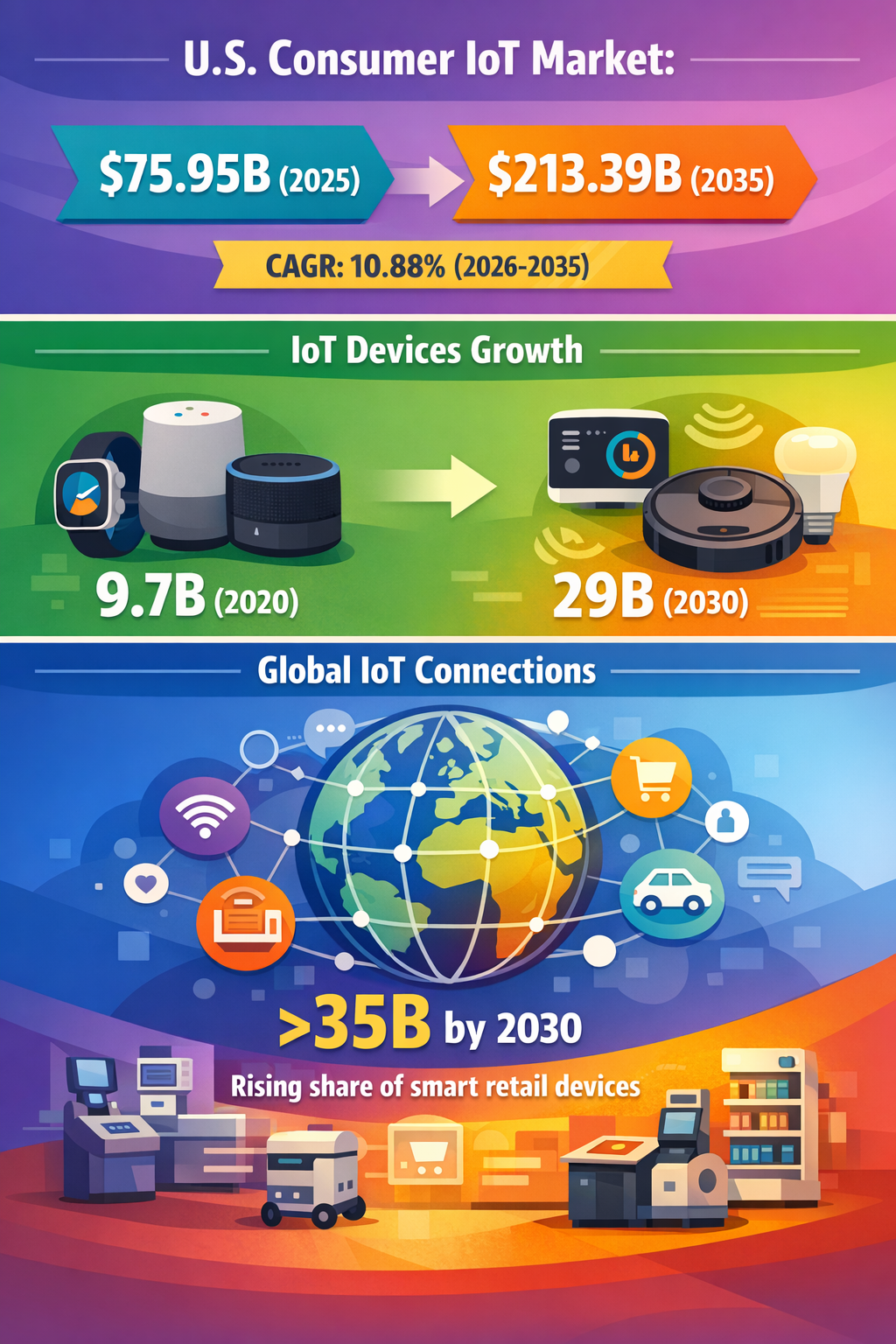
Current trajectory projections indicate explosive growth in IoT devices, escalating from 9.7 billion in 2020 to as much as 29–35 billion by 2030 (Fortinet 15/08/2023; Persistence Market Research 02/12/2023). This explosion fuels demand for ubiquitous, high-bandwidth, and low-latency connectivity services. Satellite broadband providers in LEO orbits, such as SpaceX’s Starlink, are positioned to play a growing role in closing global connectivity gaps (Oxford Economics 14/12/2023).
Traditionally, satellite broadband architectures emphasize maximizing throughput and spectrum efficiency with limited onboard data manipulation. However, the shift toward integrating AI directly on satellites changes this dynamic drastically. Next-generation Starlink satellites anticipate “substantially larger solar arrays per satellite” to sustain AI processing workloads in orbit (Exterraj 11/05/2024). This represents a concrete inflection from primarily communication-oriented payloads to computationally intensive platforms requiring sustained high power supply—a structural departure.
While 5G is expected to dominate mobile connections by 2030 and underpin many IoT applications (Springer 09/03/2024), satellite broadband’s on-orbit AI introduces an architectural conflict: power generation and thermal management constraints limit satellite design scalability and push toward higher upfront capital expenditures. This demand complicates satellite manufacturing supply chains and raises barriers to entry and deployment speed, ushering a decoupling between the pace of device connectivity growth and the physical infrastructure’s ability to scale sustainably.
Further, the convergence of AI and IoT at the satellite-edge interface may heighten cybersecurity risks (e.g., unauthorized access exploiting automation and AI-based processes), as flagged in contexts involving automation and privilege credential management in enterprises (Persistence Market Research 25/11/2023). This magnifies regulatory and governance complexities beyond traditional spectrum allocation and orbital debris concerns.
Disruption Pathway
Incremental improvements in solar array efficiency and satellite power systems may temporally moderate the pressure. However, sustained exponential increases in AI processing demands onboard satellites are likely to drive a step-change in satellite design mandates, requiring:
- Material and manufacturing innovations to accommodate significantly larger and more efficient solar arrays, elevating production costs and capital intensity.
- Adapted launch infrastructures capable of deploying heavier payloads with associated higher costs and longer development cycles.
- Enhanced ground station infrastructure to complement satellite-edge AI processing with adaptive load balancing and AI orchestration across networks.
These strains on existing satellite system economics may provoke industrial consolidation or vertical integration, rewarding firms controlling advanced materials, AI chipsets optimized for space, and vertically integrated constellation deployment capabilities.
Regulators might be compelled to revisit spectrum policies and orbital slot allocations as AI-enabled satellites' operational profiles change interference patterns and spectrum usage intensity. The increased power requirements could also accelerate environmental scrutiny of satellite manufacturing and space debris risk if larger solar arrays increase structural complexity and collision potential.
This pathway may feature feedback loops: increases in satellite power facilitate richer AI processing onboard, which further raises power demands. Delays or failures in solar array scalability could stall constellation deployments, reshuffling competitive positioning globally. Emerging spacefaring nations and private sector actors could gain strategic advantage by leapfrogging existing design paradigms focused on brute communication capacity toward computational efficiency.
Why This Matters
Capital allocators face a hidden risk: the need for disproportionately higher initial investments in satellite power systems could shift expected returns and impact valuation models for satellite broadband ventures. Investments optimized for bandwidth expansion alone may be insufficient or misaligned.
Regulators and standard-setting bodies must anticipate altered regulatory touchpoints, particularly encompassing spectrum management, AI governance in space, and environmental considerations related to enhanced energy consumption and solar array scale. Cybersecurity protocols will require reinforcement as AI edge-processing satellites potentially become attack vectors or failure points in global connectivity.
Industrial strategies must pivot to integrate cross-domain innovation combining satellite power systems, AI hardware, and network orchestration. Companies and governments failing to internalize these changes risk strategic obsolescence or weakened market positions in a connectivity ecosystem increasingly dependent on smart edge infrastructure beyond terrestrial confines.
Implications
This overlooked trend may well recalibrate industry cost structures and regulatory frameworks over the next two decades. It could catalyze a bifurcation in satellite broadband providers—those who internalize the power demand inflection and those constrained by traditional architectures.
It is unlikely the power escalations represent mere incremental scaling of past designs; rather, they might prompt a systemic redesign of satellite constellations and complementary earthbound infrastructure. This development could disrupt expected capital flows and accelerate industrial convergence in aerospace, AI semiconductors, and energy systems domains.
However, some interpretations posit that advances in solar technologies or alternative power sources (e.g., nuclear microreactors) could alleviate this power bottleneck, relegating it to a temporary design challenge rather than a structural pivot. The debate over AI workload distribution—onboard versus terrestrial—also remains open, influencing eventual impact scope.
Early Indicators to Monitor
- Increased patent activity in satellite solar array technologies and space-grade AI chipsets.
- Shifts in procurement tenders favoring satellites with enhanced on-orbit processing capacity and larger power budgets.
- Emergence of regulatory consultative processes or filings addressing AI governance and power consumption in satellite operations.
- Venture capital and institutional investment clustering in satellite AI-edge processing startups or integrated power system manufacturers.
- Public disclosures of next-generation LEO constellation designs emphasizing power infrastructure scaling.
Disconfirming Signals
- Breakthroughs dramatically increasing the efficiency of AI processing chips reducing on-orbit power needs substantially.
- Commercial preference or regulation forcing AI processing workloads off satellites and back to terrestrial or cloud infrastructures.
- Global regulatory moratoria or limitations on satellite solar array scaling due to environmental or space debris concerns.
- Disruptive alternative connectivity architectures (e.g., quantum networks, photonic systems) obviating need for computationally intensive satellites.
Strategic Questions
- How are capital allocation and R&D investments being recalibrated to account for rising power and processing demands in future satellite broadband projects?
- What regulatory frameworks will be required to simultaneously address spectrum utilization, AI governance, cybersecurity, and environmental impacts of power-hungry satellite constellations?
Keywords
LEO satellites; AI edge processing; Satellite solar arrays; Satellite broadband; Connectivity infrastructure; IoT growth; Regulatory frameworks; Space power systems
Bibliography
- The next-generation Starlink architecture is widely expected to require substantially larger solar arrays per satellite than the current constellation, driven by the power requirements of on-orbit AI processing workloads. Exterraj. Published 11/05/2024.
- Expanding Low Earth Orbit satellite broadband could help narrow global connectivity gaps and generate substantial economic benefits by extending high-quality internet access to unserved and underserved communities. Oxford Economics. Published 14/12/2023.
- The number of IoT devices will grow from 9.7 billion in 2020 to 29 billion by 2030. Fortinet. Published 15/08/2023.
- Global IoT connections are projected to exceed 35 billion by 2030, with smart retail devices representing a growing share. Persistence Market Research. Published 02/12/2023.
- In the context of IoT and AI convergence, the U.S.-China Economic and Security Review Commission has explicitly flagged risks of unauthorized access to enterprise data systems a concern directly applicable to RPA bot credentials and privileged access management. Persistence Market Research. Published 25/11/2023.
- By 2030, 5G is expected to represent more than half of all mobile connections, emerging as the dominant mobile technology. Springer. Published 09/03/2024.