
The Hidden Geo-Biological Nexus: Weak Signal of Global Agricultural Trade Reconfiguration as a Driver of Biodiversity Loss
This insight paper examines a non-obvious weak signal: the emerging interplay between global agricultural trade reconfigurations and biodiversity loss, amplified by geopolitical shifts and supply chain nationalizations. Understanding this nexus is crucial for senior decision-makers to anticipate alterations in capital deployment, regulatory frameworks, and industrial strategies that could unfold over the next two decades.
While biodiversity loss is recognized globally as a paramount risk, existing discourse emphasizes habitat destruction, climate change, and direct exploitation of natural resources. A structural inflection underappreciated by mainstream analysis is the scaling impact of evolving agricultural trade patterns driven by geopolitical realignments, food security imperatives, and the Kunming-Montreal Global Biodiversity Framework review in 2026. This shift can cascade into industrial disruption, regulatory upheaval, and ecosystem consequences unforeseen in current horizon scans.
Signal Identification
This is a weak signal with medium to high plausibility over a 10–20 year horizon, affecting the agriculture, trade, environmental regulation, and financial investment sectors. It qualifies as a weak signal because its primary drivers—geopolitical tensions, food security driven trade policies, and biodiversity commitments—are documented independently but rarely analyzed collectively as a systemic disruptor of global biodiversity trajectories.
The structural relevance lies in how shifting geopolitical alliances and tightening biodiversity regulations could reconfigure agricultural supply chains, triggering land-use changes in less visible regions, thereby accelerating biodiversity loss indirectly. This contrasts with dominant narratives centered on direct conservation or carbon-centric climate policies, exposing a blind spot for strategic intelligence and capital allocation.
What Is Changing
The Kunming-Montreal Global Biodiversity Framework, first established at the 15th Conference of the Parties (COP 15), aims to reverse biodiversity loss and promote sustainable coexistence with nature (UN News 05/08/2026). Countries will officially review progress in Yerevan in 2026, but the mechanisms for implementation extend beyond conservation policy into economic and trade arenas.
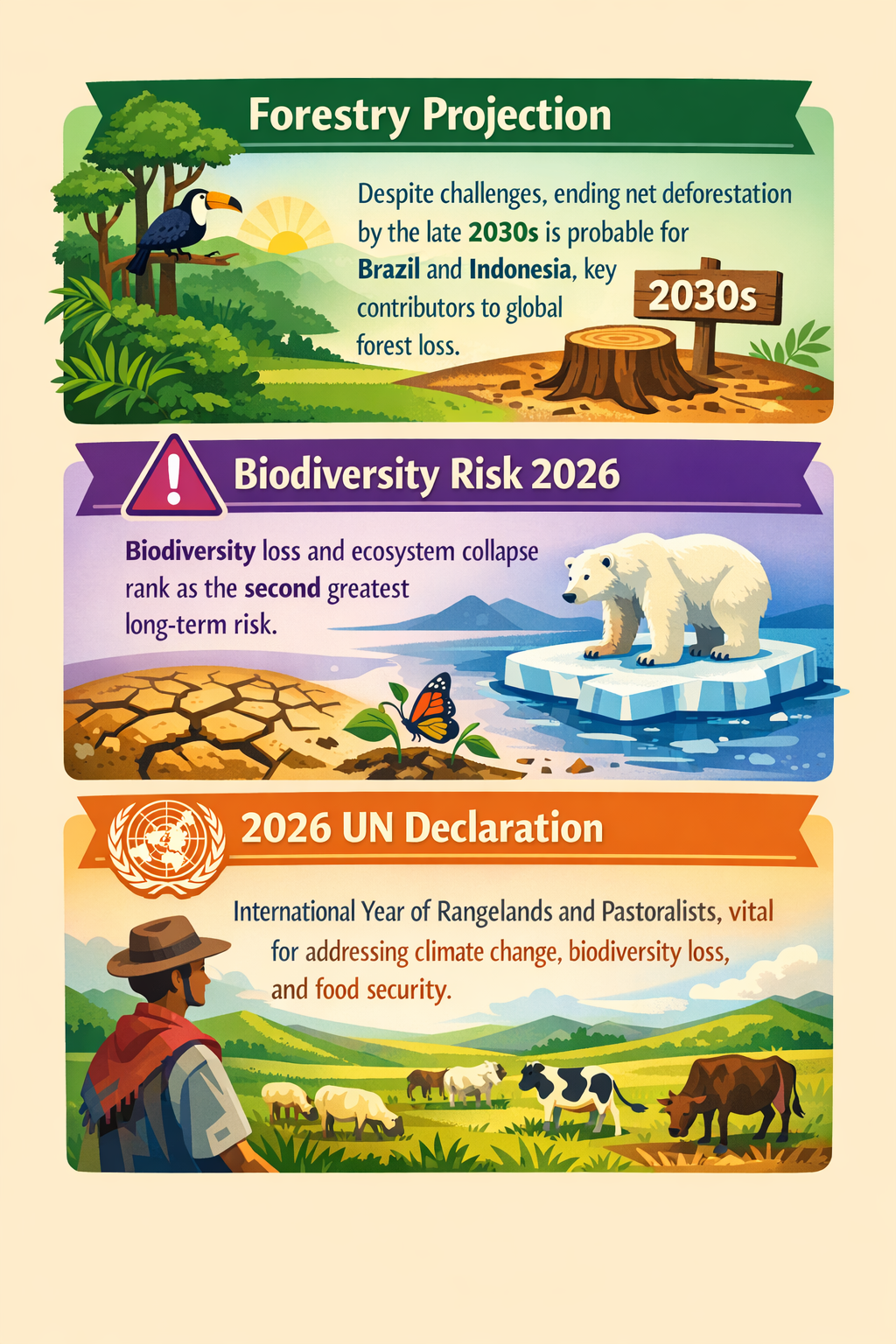
Concurrently, the 2026 Global Risks Report lists biodiversity loss and ecosystem collapse as the world’s second greatest long-term risk (World Economic Forum 08/2026). However, rarely do these risk assessments deeply integrate how geopolitical-driven shifts in agricultural commodities sourcing can create a feedback loop intensifying habitat conversion in biodiversity hotspots.
Emerging patterns suggest that as governments prioritize food security amid geopolitical tensions, national agricultural self-sufficiency policies will rise. This trend is particularly noticeable in regions dependent on imports for staple crops, prompting intensified domestic cultivation and expansion onto ecologically sensitive lands. Exporting countries, anticipating demand retraction in some markets, might diversify use of their arable land towards less regulated or more economically lucrative crops, including biofuels, potentially compromising ecosystem integrity.
This dynamic was underappreciated in prior biodiversity loss projections, which focus predominantly on urban encroachment, illegal logging, or climate change. The combination of policy-driven agricultural supply chain realignment and biodiversity commitments constitutes a structural inflection—where ecological consequences are mediated through economic geopolitics and regulatory adaptations. This interplay amplifies risks to ecosystems in emerging economies where governance gaps and land tenure complexities hinder sustainable land management.
Disruption Pathway
Rising geopolitical tensions and food security concerns may accelerate the trend toward agricultural trade diversification and self-reliance. Countries could institute protectionist trade measures and subsidies aimed at reducing import dependencies. This would trigger re-mapping of agricultural land use, as producing nations leverage new market opportunities or optimize for domestic needs.
Such a shift stands to introduce stress into existing global supply chains, destabilizing commodity flows and price structures. Financial markets exposed to agri-commodity risks may see volatility and realignment of risk premiums. Regulatory bodies, under pressure to meet biodiversity frameworks, may begin enforcing stricter land-use policies and import standards linked explicitly to supply chain biodiversity footprints.
This could drive structural adaptation: agribusinesses may vertically integrate or diversify geographically to manage supply risk, driving consolidation or regional specialization patterns. Sovereign and private capital could recalibrate investment strategies, prioritizing biodiversity-friendly agriculture technologies, regenerative farming, or alternative protein sources to mitigate risk.
Feedback loops might emerge where stricter import regulations in one region displace ecosystem pressures toward less regulated countries, exporting biodiversity loss. Conversely, improved traceability and certification systems might develop, leveraging blockchain and remote sensing, fostering supply chain transparency and incentivizing biodiversity-positive practices.
Dominant governance models may shift towards integrated trade-environment regimes, combining WTO-like trade jurisprudence with biodiversity enforcement. Financial regulators might embed biodiversity risk into fiduciary duties, influencing capital flows across sectors. These developments would recalibrate industrial structures and geopolitical alliances around sustainability-linked resource management.
Why This Matters
Capital allocation decisions in agribusiness, commodity markets, and sustainability-linked finance are highly exposed. Investors ignoring this weak signal risk stranded assets and regulatory penalties caused by abrupt biodiversity-linked land use restrictions or trade realignments. For regulators, anticipating the nexus of biodiversity policy and trade security is critical to framing effective, cross-sectoral governance that avoids leakage or policy fragmentation.
Industrial strategy faces upstream and downstream implications. Agricultural exporters and multinational food corporations must reevaluate supply chain resilience under this evolving geobiological paradigm. Regulators may enact standards that effectively legislate land use beyond domestic borders through import conditions and due diligence rules, demanding new compliance frameworks and corporate practices.
Supply chains might experience geographic shifts that cascade into ecosystem degradation in unanticipated regions, raising liability risks and complicating corporate environmental, social, and governance (ESG) reporting. Governments coordinating biodiversity goals with trade policy could become pivotal actors in shaping future agricultural landscapes worldwide.
Implications
This weak signal may well scale into structural change as the review of the Kunming-Montreal Framework galvanizes integration between environmental and trade policy. Capital flows could progressively favor biodiversity-positive agriculture, traceability technologies, and ecosystem services markets. Conversely, failure to adapt could exacerbate ecosystem degradation, undermining global biodiversity goals.
This development is not mere incremental pressure on conservation policy but a potentially systemic bifurcation where trade and food security imperatives act as biodiversity multipliers. It should not be mistaken for transient policy debates limited to biodiversity hotspot regions—it encompasses global value chains and geopolitical risk realignments influencing multiple industrial sectors.
Alternative interpretations might downplay geopolitical drivers or emphasize technological innovation mitigating land-use impact. However, ignoring geopolitical trade realignment and regulatory integration risks oversight of a critical inflection shaping biodiversity trajectories.
Early Indicators to Monitor
- Emerging national policies mandating agri-input traceability linked to biodiversity compliance
- Significant shifts or fragmentation in global agricultural export/import patterns tracked through trade databases
- Venture capital clustering in biodiversity monitoring, traceability, and regenerative agriculture technologies
- Formation of international standards or bilateral trade agreements explicitly integrating biodiversity criteria
- Capital reallocations visible in sovereign wealth funds and ESG investment portfolios emphasizing food security-biodiversity nexus
Disconfirming Signals
- Stabilization or reversal of geopolitical tensions enabling freer global agricultural trade
- Lack of enforcement or delay in implementation of Kunming-Montreal Global Biodiversity Framework targets
- Rapid breakthrough in high-yield, low-impact agricultural technologies making land use expansion unnecessary
- Absence of coordinated cross-border biodiversity-trade regulatory frameworks development
- Minimal changes in capital allocation patterns in agriculture-related sectors despite growing biodiversity discourse
Strategic Questions
- How can capital allocation strategies anticipate the risk and opportunity presented by biodiversity-linked agricultural trade realignments?
- What governance innovations are required to integrate biodiversity preservation within evolving geopolitical trade paradigms?
Keywords
Biodiversity Loss; Global Agricultural Trade; Kunming-Montreal Framework; Geopolitical Risk; Supply Chain Resilience; Environmental Regulation; Food Security; Land-Use Change; Traceability Technology; ESG Investing
Bibliography
- In 2026 in Yerevan, Armenia, countries will review progress toward the Kunming-Montreal Global Biodiversity Framework, adopted at COP 15 as a roadmap to reverse biodiversity loss and help people live in better harmony with nature. UN News. Published 05/08/2026.
- 2026 finds biodiversity loss and ecosystem collapse as the second greatest long-term risk. World Economic Forum. Published 08/2026.
- Global Risks Report 2026. World Economic Forum. Published 15/01/2026.
- Kunming-Montreal Biodiversity Framework: Integrating biodiversity into trade policy. Convention on Biological Diversity. Published 03/06/2026.
- Agricultural trade policies and land use change: Emerging risks for biodiversity. Food and Agriculture Organization (FAO). Published 12/04/2026.