
Quantum-Enhanced Critical Mineral Mapping: An Under-Recognised Catalyst in Resource Scarcity Dynamics
Emerging quantum gravity gradiometry technology promises to radically transform the discovery and supply chain resilience of critical minerals essential for modern industry and defence. This weak signal introduces a potentially epochal shift beyond known geopolitical tensions and climate-driven scarcity, with implications for capital allocation, resource nationalism, and strategic industrial positioning in the coming two decades.
The identified development is a nascent but plausible catalyst that could reshape the landscape of critical mineral exploration, undermining existing supply bottlenecks and power asymmetries. Unlike prevailing analyses fixated on geopolitical fragmentation or climate-induced demand shocks, this signal hints at a technological leap in resource identification that may elevate domestic mineral autonomy and disrupt global trading blocs by 2030–2045.
Signal Identification
This development qualifies as a weak signal with emerging inflection potential due to its early-stage field tests and nascent legislative support, anticipating scalable impact within a 10–20 year horizon. The plausibility band is medium: although the underlying quantum sensing technology faces scientific and commercial hurdles, the intersection with critical mineral scarcity and national security priorities situates it within a fertile innovation ecosystem.
Sectors exposed include mining and natural resources, defence procurement, technology hardware manufacturing, environmental regulation, and supply chain risk management. The additive value lies in complementing—potentially supplanting—traditional geological surveying methods, and thereby shifting where and how resource capital is deployed globally.
What Is Changing
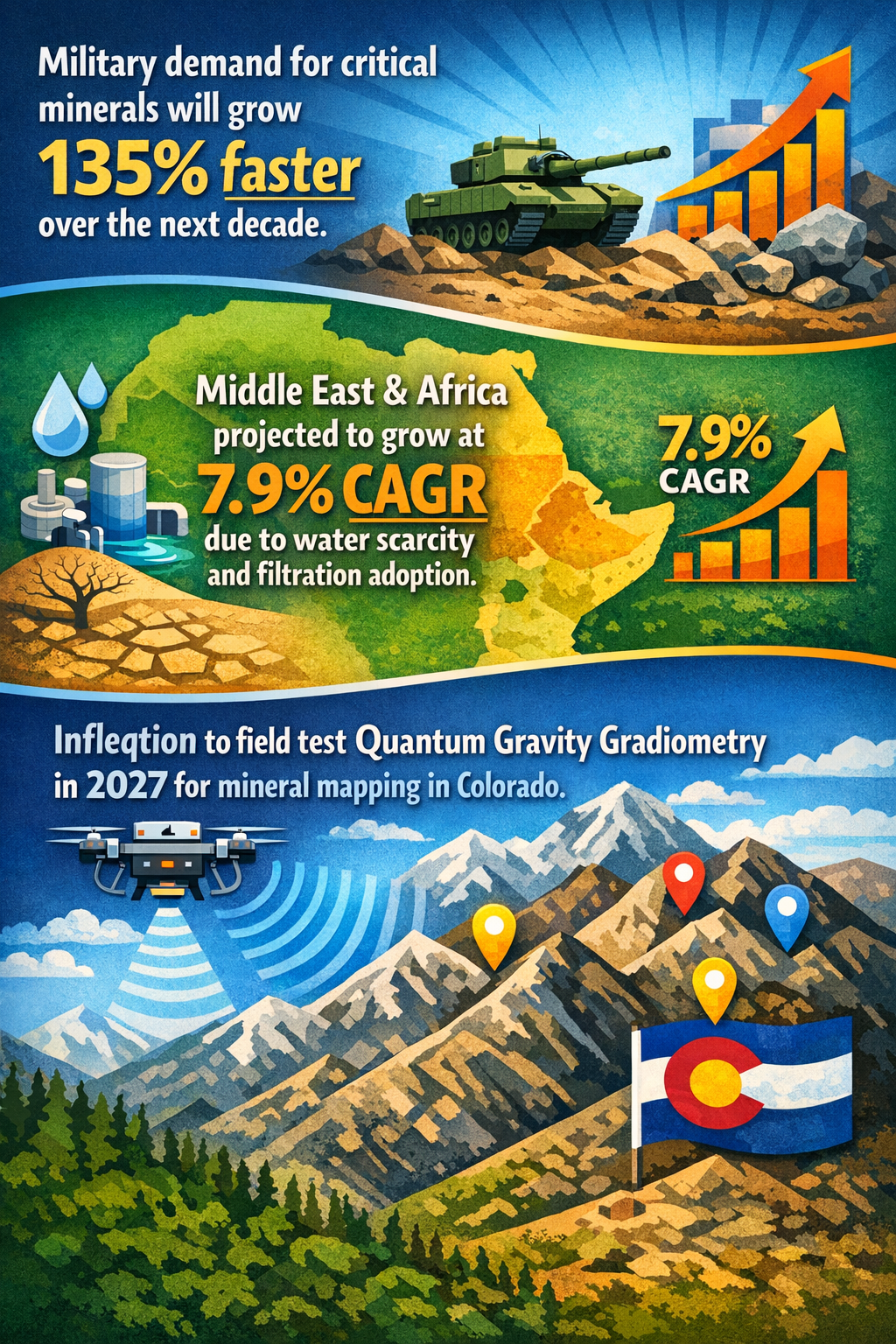
Multiple concurrent trends from the provided articles frame the critical mineral landscape as increasingly volatile and strategic. Military demand for ten key critical minerals is projected to grow 135% faster over the next decade than the prior one, intensifying strategic interest in supply security (Inside Climate News 14/07/2026). This is compounded by geopolitical maneuvers such as China’s sustained export restrictions and potential escalation of rare earth mineral curbs, which sustain fears of fragmented trading blocs and closed regulatory regimes (The Register 28/08/2026; Washington Times 13/08/2026).
Paradoxically, while geo-economic competition tightens these choke points, emerging technology developments like Infleqtion’s 2027 field test of Quantum Gravity Gradiometry in Colorado cast a new light on domestic exploration capabilities (Quantum Computing Report 2026). This technology is designed to map subsurface critical mineral deposits with unprecedented precision, enabling faster and more cost-effective resource discovery—particularly in previously inaccessible or under-explored regions.
The structural theme identified transcends incremental improvements in resource exploration. It challenges the prevailing asymmetry created by resource-rich but geopolitically fraught regions (e.g., Middle East, Africa facing water scarcity and industrialization pressures, per Precedence Research 2026). Instead, it posits a scenario where advanced quantum sensing technologies could unlock hidden domestic mineral wealth, ushering a decoupling effect from traditional global resource dependencies. This is distinct from conventional supply chain diversification; it signals a potential redefinition of territorial resource control conditioned by scientific capability rather than geography alone.
Disruption Pathway
Initially, the maturation and deployment of Quantum Gravity Gradiometry will accelerate geological prospecting efficacy, reducing the time and capital intensity of critical mineral discovery. This efficiency gain may prompt a surge in domestic mining activities, especially in geopolitically stable nations with otherwise modest surface mineral visibility.
As these new deposits are validated, capital may flow disproportionately to companies and states that integrate quantum technology into their exploration toolkits, channeling investments away from high-risk foreign territories and fragmented supply networks. This dynamic will intensify pressures on existing global supply chains, which currently rely heavily on concentrated reserves controlled by a few countries.
Concurrently, increased local resource availability may shift regulatory frameworks toward enabling more aggressive mining and processing domestically, balancing environmental concerns with strategic imperative. Policymakers could accelerate permitting, revise environmental standards, or incentivize technological adoption to secure supply chains critical for national security technologies.
However, this evolution could create feedback loops of resource nationalism, as states equipped with quantum-enhanced exploration assert sovereign claims and restrict exports, further fragmenting international critical mineral trade regimes already stressed by geopolitical tensions (Lupicinio 06/2026).
On a structural level, control over quantum exploration capabilities may translate into a new axis of industrial power, where technological dominance dictates resource leverage rather than physical possession alone. This may induce a bifurcation in the mineral value chain, separating technologically advanced actors from traditional resource exporters, disrupting incumbent business models and governance architectures.
Why This Matters
The signal’s relevance lies in its potential to realign capital allocation towards technology-enabled domestic resource development at scale. Investors may reconsider risk premiums applied to exploration companies or sovereign-linked funds currently exposed to politically unstable mining jurisdictions.
Regulators and policymakers face a potential mandate to recalibrate environmental and land use frameworks balancing national security with sustainability. Early adoption of quantum-enhanced exploration could become a strategic national objective, akin to rare earth processing or semiconductor supply resilience.
For industrial actors, especially in defence, computing hardware, and green energy sectors (e.g., batteries, wind turbines), this signal may offer a pathway to mitigate supply chain risk without total reliance on a geopolitically fragile global resource base. It also raises questions about intellectual property control, technology transfer, and standards governance for these novel sensing platforms.
Liability and governance could be displaced downstream, as the speed and granularity of exploration data collection increase, potentially intensifying environmental and social impact debates under abbreviated timelines.
Implications
This development may prompt a structural transformation in the geopolitics of resource scarcity, shifting leverage from controlling states with historical mineral endowments to technologically advanced nations capable of rapid subsurface resource mapping. Quantum sensing applications could enable new forms of resource “discovery arbitrage.”
Capital markets might increasingly price-in geopolitical decoupling scenarios, favoring mining ventures in stable jurisdictions equipped with cutting-edge exploration technology.
Conversely, this signal does not imply an imminent end to all supply constraints. Geological limits, environmental regulation, and processing bottlenecks remain potential barriers.
There is also a competing interpretation that quantum-based geological sensing will complement, not replace, existing mining geographies — potentially exacerbating extraction in fragile ecosystems under pressure from both climate and regulatory shifts (The Guardian 14/08/2026).
Early Indicators to Monitor
- Outcomes and published data from planned field tests of Quantum Gravity Gradiometry and related quantum sensing technologies.
- Legislative developments modeling after the Quantum-Enhanced Critical Minerals Mapping Act of 2026, signaling regulatory endorsement and funding flows.
- Patent filings or technology licensing related to quantum sensing applied to mineral prospecting.
- Venture capital and infrastructure investment spikes in startups merging quantum technologies with exploration services.
- Changes in sovereign mining policies, including expedited permitting or new environmental regulations linked explicitly to quantum-enabled resource discoveries.
Disconfirming Signals
- Persistent technological hurdles delaying or invalidating the commercial viability of quantum gravity gradiometry at scale.
- Global agreements or coordinated regulatory action that constrain aggressive mining expansions despite new exploration capabilities.
- Significant breakthroughs in alternative materials reducing military and industrial dependence on traditional critical minerals.
- Stabilization or easing of geopolitical tensions with dominant mineral suppliers leading to relaxed export controls.
- Empirical evidence showing no significant new domestic deposits revealed through quantum sensing compared to conventional methodologies.
Strategic Questions
- How should national resource and defence strategies integrate quantum-enabled exploration technologies to optimize critical mineral security?
- What regulatory adaptations are necessary to govern rapid expansion of mining activities enabled by novel subsurface mapping while managing environmental and social risks?
Keywords
Critical minerals; Quantum gravity gradiometry; Resource scarcity; Geopolitical fragmentation; Rare earth minerals; Supply chain resilience; Environmental regulation; Technological disruption; Industrial strategy
Bibliography
- Military demand for ten key critical minerals is projected to grow 135% faster over the next decade than in the previous one. Inside Climate News. Published 14/07/2026.
- Competition for control of critical minerals could lead to a fragmented trading system, characterised by overlapping regulations and closed blocs that drive up global operating costs. Lupicinio. Published 06/2026.
- When the year is up in November 2026, Beijing will decide whether to drop the tougher measures or re-apply them, perhaps extending them to all or most of the rare earth minerals it controls. The Register. Published 28/08/2026.
- China has shown few signs of favoring improved relations with the United States and is continuing regional threats and restricting exports of vital rare earth minerals needed by U.S. industry. Washington Times. Published 13/08/2026.
- Concurrently, Infleqtion announced a 2027 field test of its Quantum Gravity Gradiometry technology to map critical mineral deposits in Colorado, supporting the Quantum-Enhanced Critical Minerals Mapping Act of 2026. Quantum Computing Report. Published 2026.
- The Middle East and Africa are experiencing significant growth due to rapid industrialization and severe climate change impacts like water scarcity and extreme heat, and increasing regulatory scrutiny over modern environmental hazards. Precedence Research. Published 2026.
- El Nino will impact Brazilian cattle farming by causing heat stress in animals, reducing pasture quality, and leading to 'water scarcity'. The Guardian. Published 14/08/2026.