
Invisible Shifts: How Remote Worker Migration Could Reshape Skills Gaps and Industrial Geographies
Emerging patterns in remote work-fueled professional migration are quietly recalibrating the future of work and skills distribution. This soft yet potentially seismic shift challenges conventional assumptions about talent pools, economic geography, and infrastructure investment. Beyond surface-level discussions about remote work, a non-obvious inflection concerns how cross-border professional mobility driven by digital nomadism and lifestyle preferences might restructure labor markets and capital flows over the next 5 to 20 years.
This paper exposes an under-recognized wildcard: the accelerating migration of skilled remote workers as a vector for systemic realignment in global labor dynamics. While skills gaps dominate discourse, the spatial redistribution of talent tied to remote work is less visible but could profoundly influence regulatory frameworks, urban-rural divides, infrastructure investments, and competitive industrial positioning. By integrating workforce mobility trends with technological and network infrastructure developments, this insight navigates beyond short-term hype to reveal a plausible pathway toward structural transformation.
Signal Identification
This development qualifies as an emerging inflection indicator because it reflects a shift from static, location-based employment paradigms toward fluid, cross-border labor market realignments. It is medium to high plausibility given current macroeconomic constraints, remote work technological enablers, and rising lifestyle migration to affordable, connected regions. The time horizon is primarily 5–20 years, intersecting labor markets, telecommunications infrastructure, urban planning, and regulatory policy domains. Sectors most exposed include professional services, technology, real estate, telecommunications, and government labor regulation. Its non-obviousness stems from the typical focus on remote work as a productivity tool or cost management strategy rather than a driver of labor migration and geospatial economic shifts.
What Is Changing
Multiple recent developments converge to surface this subtle yet impactful inflection. A labor analysis shows younger professionals increasingly relocating from their home countries (notably the UK) to lower-cost, high-quality-of-life destinations such as Spain, enabled by remote work opportunities (The HR Director 01/06/2026). This migration trend contrasts with prior decades where retirees drove emigration patterns, indicating a meaningful reorientation of demographic flows driven by digital work capabilities.
Simultaneously, federal infrastructure decisions are bifurcating telecommunication quality, distributing robust, low-latency connections unevenly and thus limiting where high-skill remote work can flourish (Benton Institute 18/04/2026). The selective expansion of network infrastructure and secure remote access technology, including zero-trust networking and Secure Access Service Edge (SASE), is fundamentally shaping which regions are attractive or viable for remote professionals (Persistence Market Research 12/05/2026).
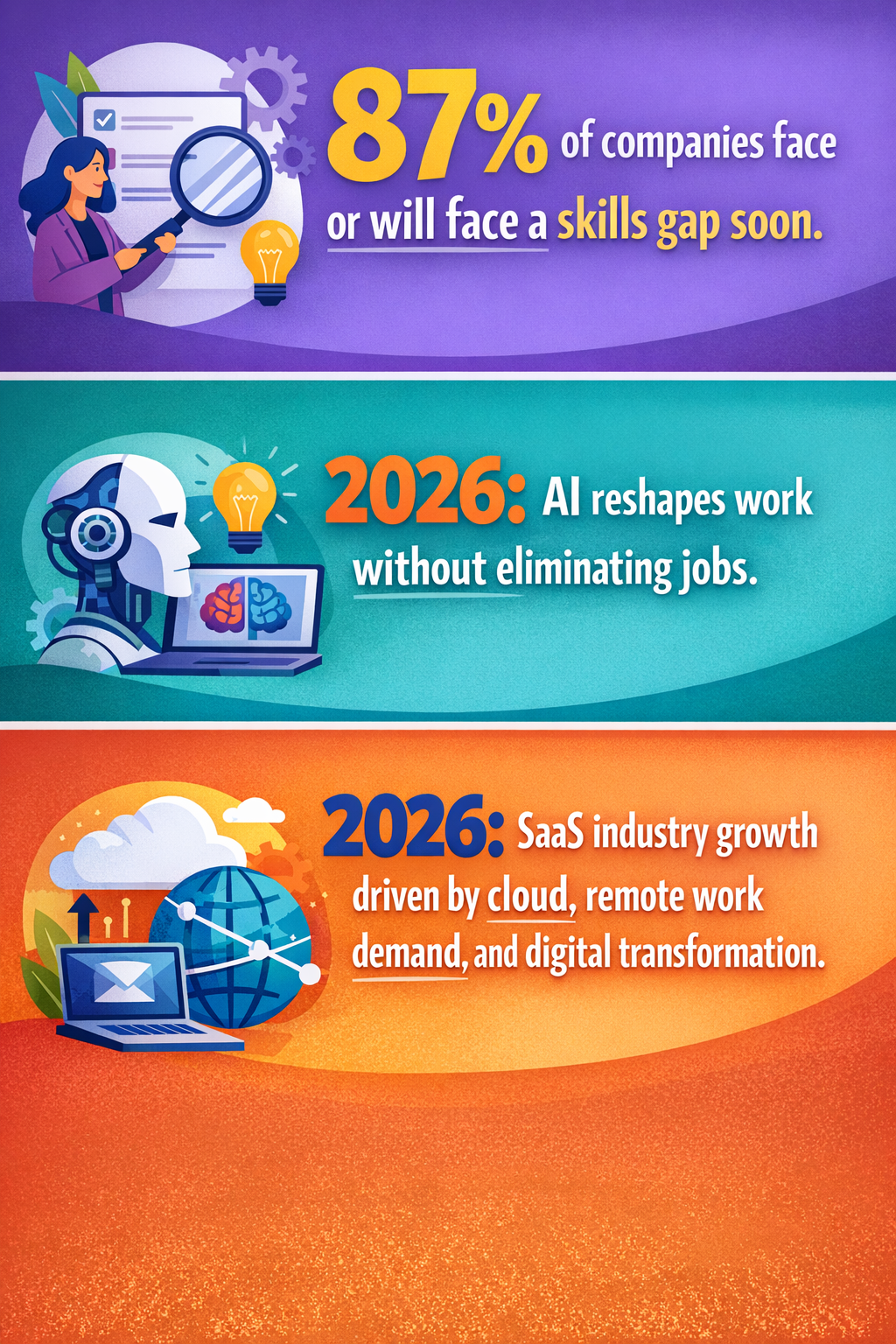
Together with booming Software-as-a-Service (SaaS) platforms designed for remote work management and collaboration, these developments facilitate not only the feasibility but the desirability of working from global, distributed locations (MaxValid 25/05/2026). Yet, the skill gap challenges confronting more than 87% of companies worldwide signal a mismatch: while talent mobility increases, companies still struggle to secure adequately skilled workers on their existing spatial and organizational terms (Aidarsi 30/03/2026).
Disruption Pathway
Initially, improved remote technologies and lifestyle motivations will increase professional migration to underserved, affordable regions with sufficient digital infrastructure. Capital allocation may shift as firms reconsider the cost-benefit calculus of investing in expensive urban centers versus distributed, decentralized talent networks. Regions previously outside core economic hubs could leverage inflows of skilled workers to develop niche industrial clusters, potentially triggering new localized ecosystems.
The resulting competitive stress on legacy urban labor markets and real estate could accelerate efforts to integrate dense digital network infrastructure with local policy incentives to retain or attract talent. Conversely, regulatory bodies may face pressure to devise frameworks for cross-jurisdictional labor standards, taxation, social benefits, and data security—issues complicated by workers simultaneously residing and serving clients in different countries.
As these conditions unfold, feedback loops may emerge: high-skill workers demand better local digital and social infrastructure, prompting reinvestment in rural or suburban regions, which in turn draws more talent and families, increasing local economic vibrancy and further widening disparities with disconnected regions. Companies might increasingly adopt hybrid hiring strategies balancing local presence with distributed workforces, reshaping industrial structures.
Secured wireless networks and zero-trust architectures could become fundamental enablers, but disparities in their availability may entrench digital divides that map onto emerging economic geographies. The interplay between technology provision, labor mobility, and regulation may redefine dominant models from centralized urban economies to dispersed, interconnected ecosystems across national and continental boundaries. The structural adaptations will likely also involve evolving liability rules and governance models for remote work environments, especially in hybrid and cross-border contexts.
Why This Matters
This insight carries vast implications for decision-makers allocating capital into real estate, telecommunications, and workforce development. Firms may need to reconsider investments tied to traditional talent pools or office-centric models. National governments and regulators will confront challenges in standard-setting for remote work across borders, data sovereignty, and equitable infrastructure provision. Industrial strategies premised on urban agglomeration economies may require recalibration toward polycentric or distributed models.
Supply chains of skills and services could experience shifts as decentralized work erodes previously fixed geographic advantages. Leadership must weigh emerging liability issues as cross-border work blurs jurisdictional lines on labor rights, taxation, and compliance. Early strategic positioning could involve investing in secondary markets with burgeoning remote-work skills clusters or championing standards in secure, equitable access to digital network infrastructure.
Implications
The migration of remote workers to new geographies may likely catalyze structural labor market changes rather than transient shifts driven purely by pandemic-induced remote work acceleration. Capital flows could veer away from conventional tech hubs, influencing real estate valuations and urban planning. Over 5–20 years, this may prompt comprehensive regulatory updates addressing cross-border employment, tax regimes, and infrastructure investment priorities.
This signal should not be mistaken for simple workforce decentralization alone; it involves a socio-economic reordering where the locus of professional skill concentration redistributes according to hybrid technological, lifestyle, and policy incentives. However, some could interpret these developments as temporary or limited by post-pandemic reversals or political constraints on migration and digital infrastructure spending.
Therefore, constructive scenario planning should integrate this factor as a plausible wildcard altering strategic assumptions in workforce development, urban economics, and industrial competitiveness, especially given the interconnected trends in secure networking adoption and SaaS platform growth that reinforce rather than dissipate this migration dynamic.
Early Indicators to Monitor
- Volumetric data on skilled professional migration patterns, especially cross-border remote worker flows in and out of secondary cities or affordable international locations.
- Public and private capital reallocation toward network infrastructure in suburban and rural regions to support remote work connectivity.
- Venture funding clustering in SaaS platforms focused on remote workforce management, cross-jurisdictional compliance, and secure access.
- Regulatory initiatives addressing telework tax frameworks, social security portability, and digital labor rights across borders.
- Patent filings and standard-setting activities related to zero-trust network solutions and distributed work cybersecurity architecture.
Disconfirming Signals
- Rapid retrenchment toward centralized urban office work post-pandemic with corresponding migration reversals.
- Failure or slow uptake of critical digital infrastructure expansion in nascent remote-work host regions, leading to connectivity bottlenecks.
- Protectionist regulatory barriers constraining cross-border remote work and professional migration.
- Significant security incidents undermining trust in distributed digital work environments.
- Strong demographic shifts diverting young professionals back to traditional metropolitan hubs for non-economic reasons (cultural, familial, educational).
Strategic Questions
- How should capital be allocated to balance traditional urban real estate and emerging remote-worker hubs in lesser-known regions?
- What governance frameworks can be developed to manage cross-border labor rights, taxation, and data security for increasingly mobile, remote-skilled workforces?
Keywords
Remote Work; Professional Migration; Skills Gap; Digital Infrastructure; Zero Trust Security; Software as a Service; Industrial Geography; Regulatory Frameworks
Bibliography
- 87% of companies either currently face a skills gap or will face one within a few years. Aidarsi. Published 30/03/2026.
- U.S. government agencies and enterprises are accelerating adoption of zero-trust networking, secure access service edge (SASE), and wireless threat intelligence platforms to protect expanding hybrid work and connected device ecosystems. / USA. Persistence Market Research. Published 12/05/2026.
- Over the past year, the federal government made choices that will shape who gets robust, low-latency connections capable of supporting telehealth, remote work, online learning, and myriad future applications and who gets a connection that merely meets a minimum threshold on paper. Benton Institute. Published 18/04/2026.
- As we move further into 2026, the SaaS industry is expected to grow exponentially, driven by advancements in cloud infrastructure, increasing demand for remote work solutions, and a surge in digital transformation initiatives. MaxValid. Published 25/05/2026.
- The global employment specialist analysed migration and labour data, finding that younger professionals are increasingly replacing retirees as the main drivers of British migration to Spain, drawn by remote work opportunities, lower living costs, and a high quality of life. The HR Director. Published 01/06/2026.